
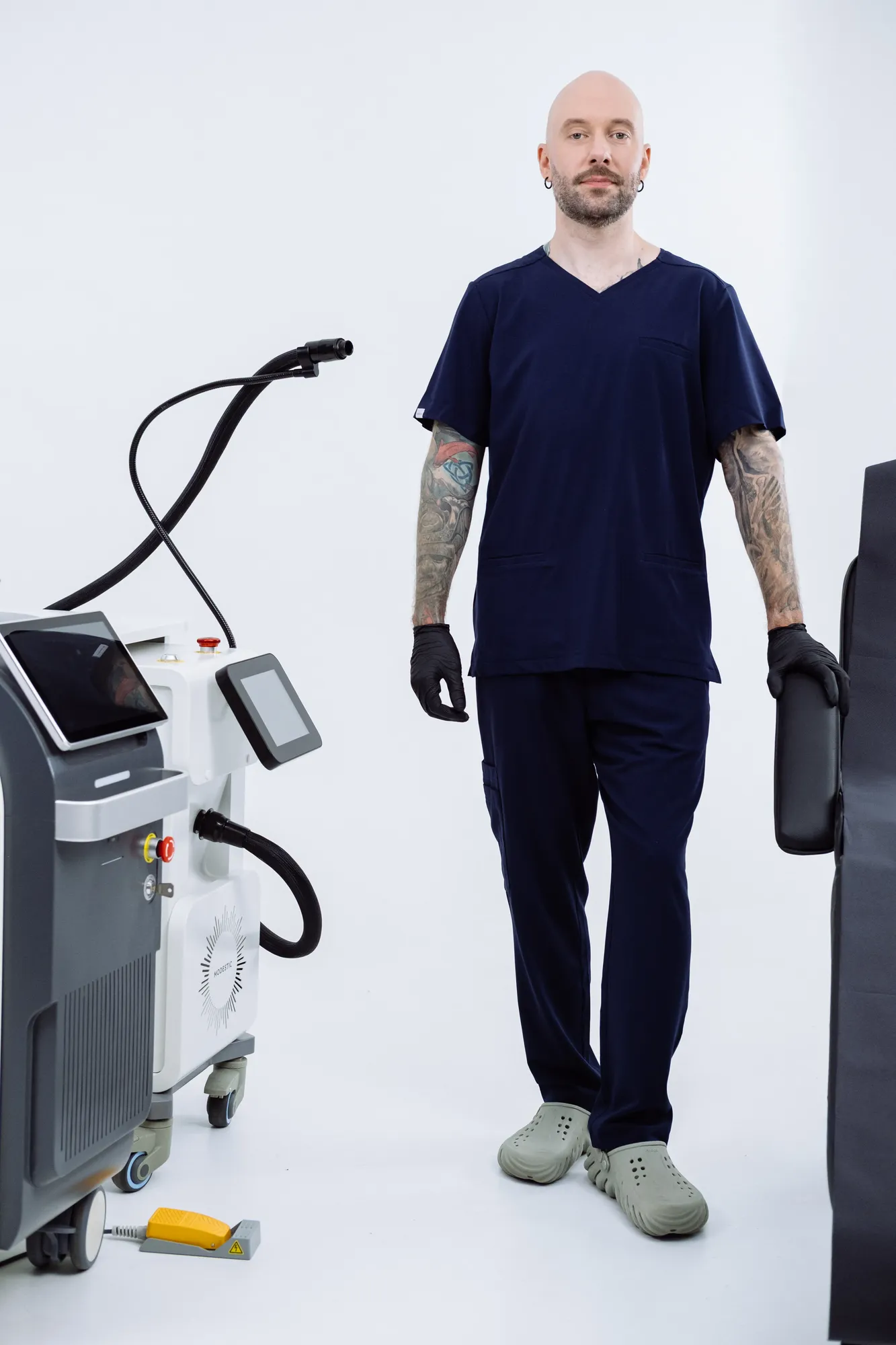
How the nanosecond laser (Q-switch) works
The Q-switch laser emits pulses of light lasting 5 to 100 nanoseconds (one nanosecond = one billionth of a second). Tattoo pigment absorbs the pulse energy, heats rapidly and breaks apart — the dominant mechanism is photothermal, i.e. heat-based. This technology has been used in aesthetic medicine for over 30 years and has a well-established track record, particularly for black and dark ink.
A longer pulse does, however, mean that more thermal energy reaches the tissue surrounding the pigment. With poorly chosen parameters this raises the risk of pigmentation changes or scarring, and difficult colours — green, blue, yellow — respond less well.
How the picosecond laser works
The picosecond laser emits pulses lasting 450 to 750 picoseconds. One picosecond is one trillionth of a second — meaning the pulse is roughly 100 times shorter than a Q-switch pulse. At such a brief duration the energy does not convert to heat; instead it generates a photomechanical (photoacoustic) shock wave that shatters ink particles mechanically into far smaller fragments.
This photomechanical effect is the core advantage of picosecond technology. You can read more about the physics in our guide on how laser tattoo removal works.
Key differences — picosecond vs nanosecond
A summary of the most important differences between the two technologies:
- Pigment fragmentation: picosecond shatters particles into smaller fragments, which the body clears more easily and quickly through the lymphatic system. In practice this means fewer sessions.
- Heat in tissue: shorter pulse = less heat reaching surrounding skin. This translates to a lower risk of hypopigmentation (skin lightening) and scarring.
- Difficult colours: green, blue and yellow require precisely matched wavelengths. Picosecond lasers are better suited to these colours than older Q-switch devices. See our article on coloured tattoo removal.
- Darker skin tones: less tissue heating means less melanin stimulation, which matters for phototypes III–VI. Details in our guide on tattoo removal and skin type.
- Technology age: Q-switch has been around for over 30 years and is still used — mainly because the equipment is less expensive. Picosecond is the standard in modern specialist removal clinics.
“A very professional approach and deep expertise. The service was done very thoroughly.”
Which laser to choose — what this means for you
When choosing a clinic it is worth asking directly: which laser do you use? A picosecond laser is today's recognised standard in professional tattoo removal — clinics that use it have greater capability in challenging cases (colours, darker skin tones, old tattoos). A Q-switch laser still removes black ink effectively, but is less optimal in other scenarios.
At Modestic we use a picosecond laser. If you would like to assess your specific case and find out how many sessions you need, book a consultation — reserve a time slot. You can find the removal price list on our pricing page.