
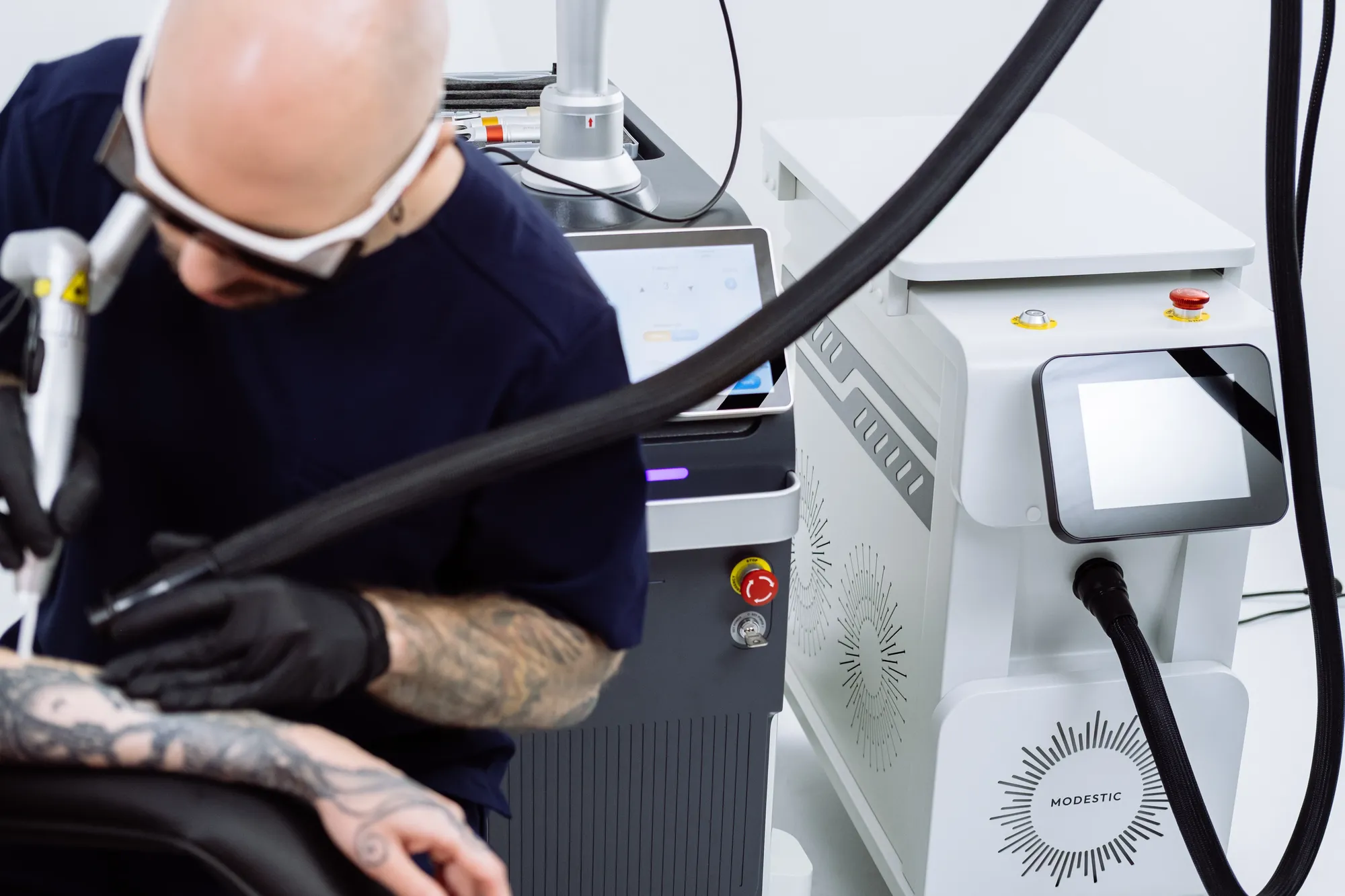
Why a tattoo is permanent
When you get tattooed, the needle deposits ink particles in the dermis — the layer below the surface of the skin. These particles are too large for immune cells to clear, so the body walls them off in the tissue and leaves them in place. That's why a tattoo lasts for years, and why creams or scrubs that act on the surface have no way to reach it.
To remove a tattoo you therefore have to reach those particles at depth and break them down enough for the body to clear them on its own. That is exactly what the laser does.
What the laser light does — the photoacoustic effect
The laser emits very short, intense pulses of light at a wavelength chosen so it's absorbed by the tattoo pigment rather than the surrounding skin. An ink particle absorbs the pulse's energy, heats instantly and then expands rapidly. That sudden change shatters the particle from the inside into microscopic fragments — we call this the photoacoustic (mechanical) effect, because the pigment is broken apart by a wave rather than simply burned.
The key point is that the energy targets the pigment, not the skin around it. With correctly chosen parameters the surrounding tissue stays largely intact, which is what keeps the scarring risk low.
The lymphatic system's role
The laser itself doesn't "pull out" the tattoo. Shattering the pigment is only half the journey — the rest is done by your immune and lymphatic system. After the treatment, scavenger cells (macrophages) pick up the tiny ink fragments and carry them away via the lymph, until the body clears them. That's why the result doesn't appear at once but builds up over the weeks after each session.
For the same reason your general health matters: good hydration, sleep, movement and not smoking all support efficient clearance. It's your body that does the work between sessions.
Picosecond technology
We work with a picosecond laser. A picosecond is a trillionth of a second — the pulse is so short that it acts on the pigment almost purely mechanically, breaking it apart with a shock wave rather than prolonged heating. In practice this means finer fragmentation of the ink, which the body finds easier to clear, with less strain on the surrounding skin.
This is a good moment to set realistic expectations — we cover that in a separate guide: is tattoo removal effective.
Why dark inks go first
The laser only acts on pigments that absorb its wavelength. Black and dark colours absorb light best, so they respond fastest and usually clear first. Some colours — light, warm, white, or UV inks — absorb light poorly and call for more patience, and certain pigments can't be removed completely.
- Respond best: black, navy, dark shades.
- Harder: light and warm colours, green, blue.
- Hardest: white, pastel colours, some UV inks.
“Quick, smooth and safe. During the treatment everything is explained step by step, with care for your comfort.”
Why it takes several sessions
A single treatment shatters only part of the pigment within reach of the pulse. After it, the body needs time to clear the fragmented ink and the skin needs time to recover. That's why we space the sessions out (usually about every 8 weeks), and the whole process is typically 8–12 sessions. Rushing doesn't speed up the result — the gaps are part of the mechanism.
Exactly how many sessions and how long it will take in your case is broken down here: how many sessions and how long tattoo removal takes. The whole process from assessment to result is described in the main guide: how to remove a tattoo.