
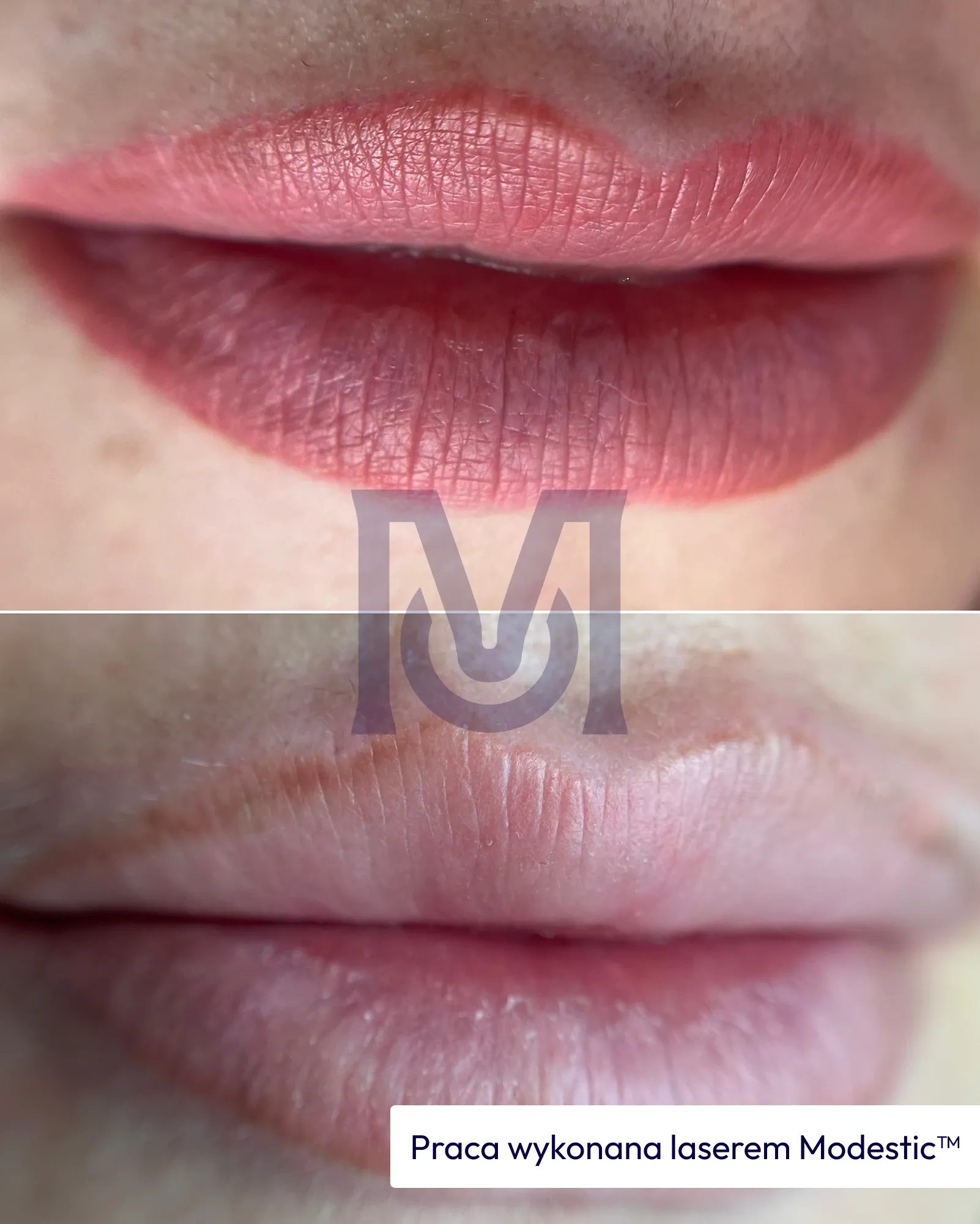
Common problems with lip PMU
Clients come to us with a wide range of situations. The most common are:
- Asymmetry in shape or contour thickness. One side noticeably higher, thicker or different from the other — especially visible when speaking and smiling.
- Wrong colour — too intense, too pink, too dark or too purple. A lip blush that was meant to look natural but resembles heavy lip liner from decades ago.
- Contour that bled outside the natural lip border. The contour line crossed the edge of the lip — an optical enlargement effect that was never intended.
- Uneven colour saturation. One part of the lips darker, another fading faster — inconsistent pigment distribution.
- Heavy, artificial "lipstick" effect. Full colour fill that creates anything but a natural look.
How to fix it — options
Before any action we perform a thorough assessment and a pigment test spot. The possible paths:
- Wrong colour, acceptable shape. Gradual lightening of the pigment, then — after healing — new permanent makeup with a better-matched pigment. The most common scenario.
- Wrong shape — contour outside the lip border. We remove the pigment from areas beyond the natural lip line first. This requires precision — the line sits close to the mucocutaneous junction and the tissue is delicate. Only after correcting the shape does it make sense to think about new makeup.
- Colour that bled beyond the contour. Targeted removal of pigment from areas outside the line — possible, but takes care and several sessions.
- Asymmetry. If the difference is minor, sometimes correcting the pigment on one side achieves balance without full removal. We assess what makes sense at the consultation.
A comparison of removal methods (laser vs. remover) is covered in: remover vs laser — what is better for PMU.
How lip PMU removal works
The process is similar to eyebrow PMU removal, with a few important differences that stem from the unique nature of the lip area:
- A test spot is mandatory. Lips are the area where the risk of paradoxical darkening of iron-oxide pigments is highest. Lip blush and contour pigments very often contain iron oxides — laser energy can cause their oxidation and temporary or permanent darkening. The test on a small section shows how your specific pigment reacts before we treat the full area.
- Lips are more sensitive than brows. We apply numbing cream before every session. The discomfort is brief, but we treat this area with extra care.
- Cold sore risk. Treatment around the lips can activate HSV in people with recurrent cold sores. In those cases we use antiviral prophylaxis.
- How sessions work. The picosecond laser breaks down pigment with short pulses. The body clears it over the following weeks. Sessions are spaced 6–8 weeks apart.
A full description of the treatment, aftercare and possible complications is in: permanent makeup lip removal.
“I've now been three times for permanent lip makeup removal. Professionalism at the highest level, clean and sterile.”
Full removal vs. correction — which applies to you
Full removal is not always necessary. We discuss this at every consultation:
- Full removal — when the colour is very wrong, the contour is significantly displaced, or the client wants to return to natural lips without permanent makeup. Typically 3–4 sessions spaced 6–8 weeks apart.
- Partial removal / lightening — when the goal is correcting specific areas or preparing a cleaner base for new pigment. Fewer sessions, less intervention.
- Makeup correction only — if the issue is purely saturation or minor asymmetry and the overall result is acceptable, sometimes a colour or shape correction without laser removal is enough.
The best plan is determined after seeing your lips in person. Consultation (250 PLN, refunded at treatment): book online. Treatment prices: price list.
You may also find it useful to read about brow corrections: botched permanent eyebrow makeup.