
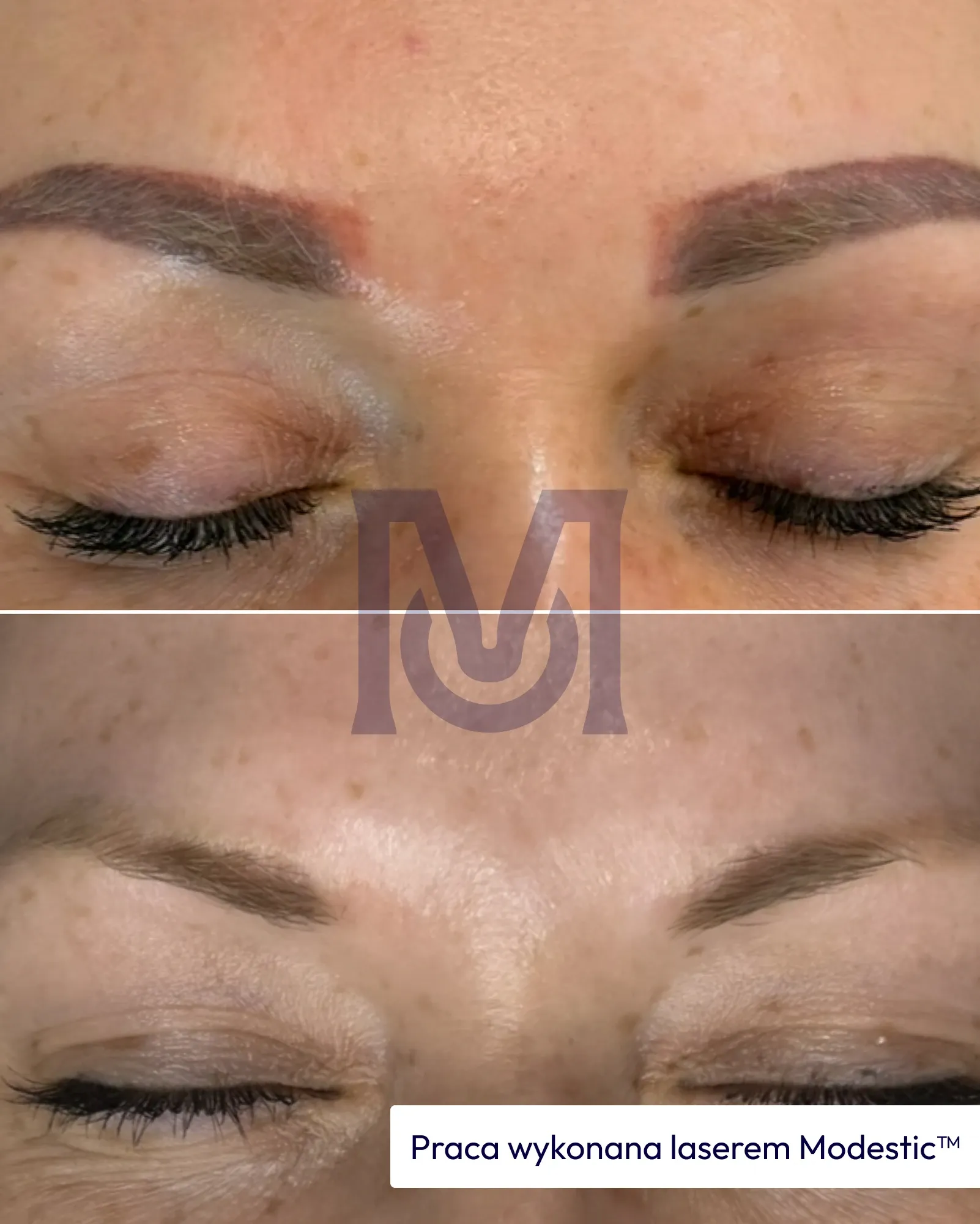
What "botched" permanent eyebrow makeup actually means
It's usually one of these (or several at once):
- Changed colour — brows drifted to blue, grey, purple or red.
- Too dark or too heavy — a "drawn-on", heavy brow look.
- Asymmetry — different shape, height or thickness.
- Blurred contour — the pigment migrated under the skin and the line is fuzzy.
- Wrong shape or badly placed line — it doesn't suit the face.
- Pigment that won't fade — it was meant to disappear and hasn't.
Each of these has a solution — only the route there differs.
Why brows turn blue, grey or red
It isn't always "bad work" — it's how pigment behaves in the skin:
- Blue and grey usually appear when the pigment was implanted too deep, or was based on particles that show through the skin in a cool tone over time (similar to why veins look blue).
- Red, ginger and orange are most often the warm "base" of iron-oxide pigments surfacing — once the darker layer fades, the warm underlayer remains.
So time alone doesn't always "even out" the colour — sometimes it deepens it. What we see tells us a lot about how the pigment will react, which is why we start with a careful assessment under good light.
Your options
At the consultation we usually discuss three paths:
- Full pigment removal — when you want a clean slate and to either start over or stay with natural brows. We do this with a picosecond laser; the details are in a separate guide: permanent eyebrow makeup removal.
- Lightening and correction — partially removing the old pigment so that later (once healed) correct permanent makeup can be done on a cleaner base. The most common scenario with "botched" brows.
- Consciously leaving it — sometimes the best decision is to wait or not intervene. We'll say so plainly if that's what we think.
You don't have to choose right away. It depends on the colour, the depth of the pigment and what you want to achieve.
How lightening and removal work
- Consultation and assessment. We look at the colour and depth of pigment, analyse your skin phototype and set a realistic goal. It costs 250 PLN, refunded at your first treatment.
- Test spot. Some pigments — especially light and warm ones — can react unusually under the laser. A small test shows how your pigment behaves before we treat the whole brow.
- The treatment. Short laser pulses break the pigment down and the body clears it over the following weeks. Brows sit close to the eyes, so we use protective eye shields.
Can it be fixed 100%
The most honest answer: it can usually be improved significantly, and often returned to clean skin — but the realistic goal depends on the pigment. So we don't promise a result blind. After the test and the first session we know far more, and we'll tell you plainly what to expect and how many sessions it realistically takes.
How many sessions, and when you can get new brows
A correction usually takes 3–4 sessions spaced 6–8 weeks apart (fewer than removing a tattoo). If you're planning new permanent makeup, it's done only after healing and once the old pigment has cleared — we agree on the best moment together. Rushing doesn't help here: the skin needs time.
“I was very scared, but Kristina dispelled all my doubts. An incredibly kind person.”
How much it costs
The price depends on the colour, the area and the number of sessions, so we give a price range at the consultation, after looking at the brows and doing the test. The consultation costs 250 PLN, refunded at your first treatment, and commits you to nothing. You'll find current price ranges in the price list, and real outcomes in the before-and-after gallery.