
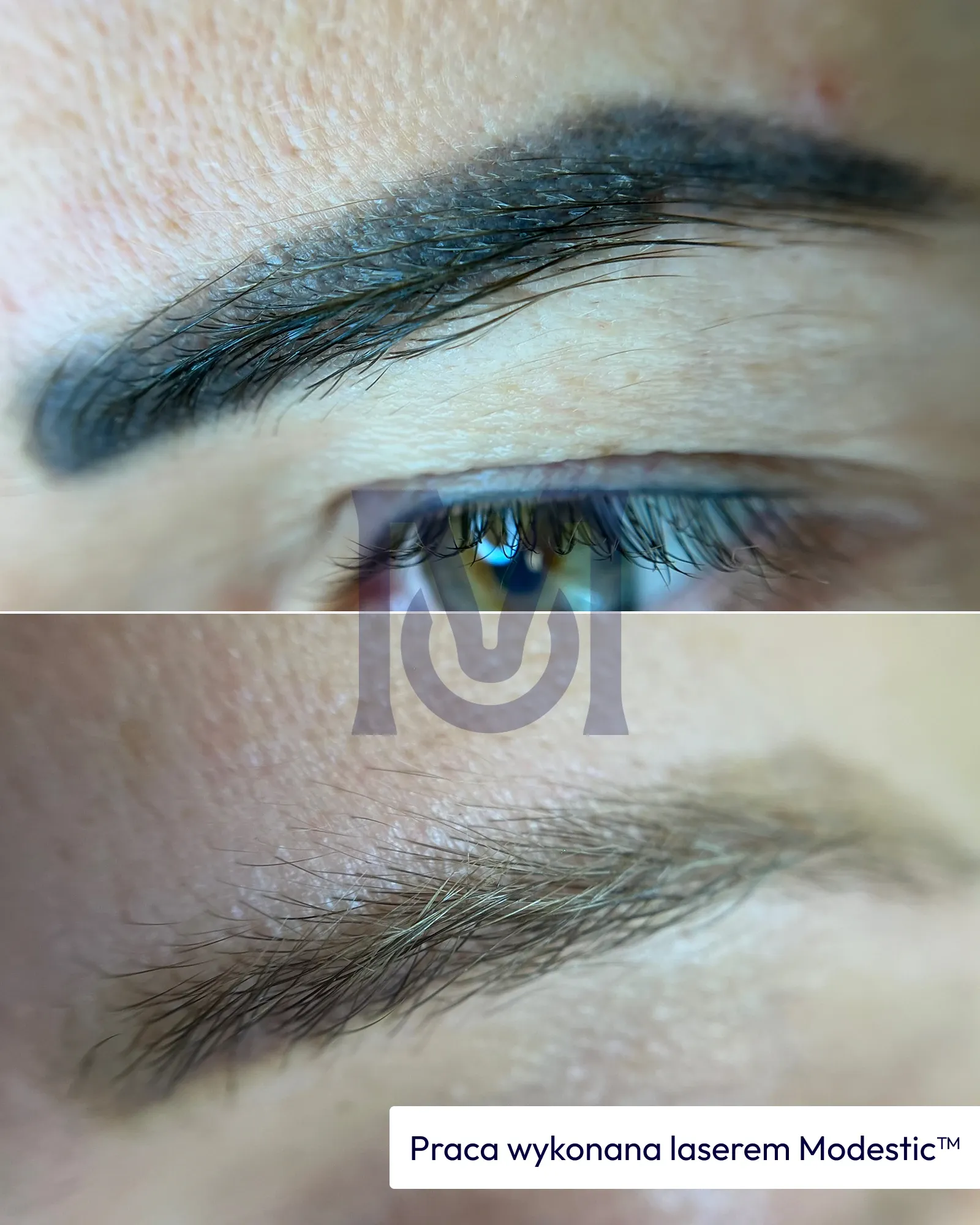
When to consider removing eyebrow PMU
The most common reasons clients come to us:
- The pigment changed colour — the brows turned grey, bluish or reddish. That's the natural result of older pigments breaking down and the depth they were implanted at.
- The shape no longer suits you — brow trends change faster than the pigment fades. Strong, dark brows from a few years ago often weigh the face down today.
- The line has spread — the contour lost its sharpness as the pigment migrated under the skin.
- The work was botched — asymmetry, too dark a colour, a line set too low. Removal is then often the first step to fixing it.
- You want a clean slate — before new permanent makeup it's better to work on skin without old pigment underneath.
You don't have to decide up front whether to remove everything or only lighten it. We settle that at the consultation, after examining the pigment under good light.
How eyebrow PMU removal works
We remove pigment with a picosecond laser. Very short pulses of light shatter the pigment particles into fragments that the body gradually clears over the following weeks. The skin stays; the pigment goes.
What a visit looks like:
- Consultation and pigment assessment. We look at the colour, depth and type of pigment, analyse your skin phototype and set a realistic plan. It costs 250 PLN, refunded at your first treatment, with no obligation.
- Test spot. With permanent makeup this is a step we never skip. Some pigments — especially light, "flesh-toned" ones and lip pigments — contain compounds that can paradoxically darken under the laser. A small test shows how a given pigment reacts before we treat the whole brow.
- The treatment. Brows sit close to the eyes, so we use protective eye shields. On such a small area the treatment is short — a few to a dozen seconds of laser work, with cooling.
How many sessions and how long
Removing permanent makeup usually takes fewer sessions than removing a tattoo — most often 3–4, spaced 6–8 weeks apart. You'll know the exact number only after seeing how the skin reacts to the first session. The count depends on:
- the type and colour of pigment (black and dark come off more easily; light and mixed — harder),
- the depth it was implanted at,
- the age of the makeup,
- your skin type.
Gaps between sessions are essential — the body needs time to clear the shattered pigment. So the whole process usually takes several months, not a single visit. We'll tell you honestly after the consultation how many sessions are realistic — including when fewer will do.
Aftercare
After a session the brows may be red, and a light scab can form — a normal part of healing. The key rules:
- don't pick scabs or rub the area,
- for a few days avoid sauna, swimming pools and heavy sweating,
- protect the area from the sun (use SPF),
- follow the written instructions you receive after the visit.
We provide full instructions in writing and stay in touch between sessions.
Is it safe, and will it scar
With correctly chosen parameters and proper aftercare the treatment leaves no scars — the skin returns to its normal appearance. Two things genuinely determine safety around the brows: eye protection (shields over the eyes) and a pigment test before the full treatment. That's why permanent makeup isn't removed "on the spot", without a prior assessment.
“The result of removing my permanent eyebrow makeup was visible after the very first session.”
How much eyebrow PMU removal costs
A price can't be given in the abstract — it depends on the area, the type of pigment and the number of sessions needed. So we set a price range at the consultation, after looking at the brows. The consultation costs 250 PLN, refunded at your first treatment, and commits you to nothing. You'll find current price ranges in the price list, and real outcomes in the before-and-after gallery.