
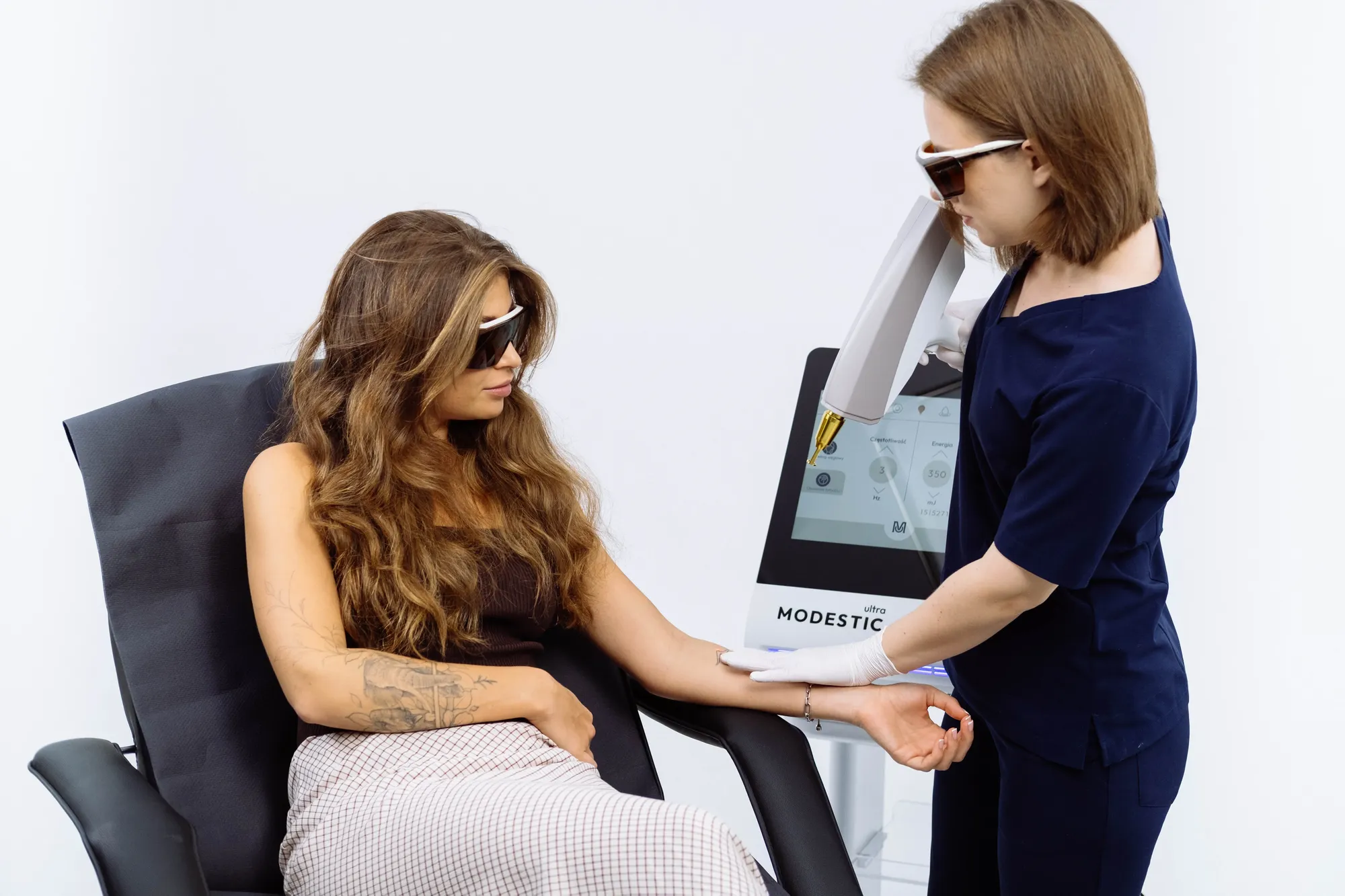
Equipment — a real picosecond laser
This is the foundation. Effective, safe tattoo removal today rests on a picosecond laser — very short pulses of light shatter the pigment into tiny particles that the body then clears. Older devices (nanosecond units or all-purpose "does everything" machines) work more slowly, need more sessions and carry a greater risk of overheating the skin.
- Ask directly what device the clinic uses and whether it's a picosecond laser.
- Be wary of "lasers" priced well below the market — often older or all-purpose equipment.
- Equipment isn't everything, though — the best laser in unskilled hands won't deliver a good result.
Experience and matching parameters to skin type
Treatment parameters are set individually — differently for light and for dark skin. Badly chosen energy risks hyperpigmentation, hypopigmentation and, in extreme cases, scarring. So the practitioner's experience matters as much as the equipment.
- Ask about experience with different skin types and ink colours.
- A good clinic can explain why it chooses those particular settings.
- We cover the safety of the treatment itself in our guide is laser tattoo removal safe.
Consultation and a test patch
A serious clinic starts with assessing the tattoo, not the till. At the consultation the skin is examined, a plan is discussed and — where it makes sense — a test is done on a small patch to see how the tattoo reacts. This is also when you should get a realistic number of sessions and a quote.
- There is no pressure for an immediate treatment, and the consultation fee is stated upfront (ours is 250 PLN, refunded at your first treatment).
- Specific questions are asked about your health, medication and the tattoo's history.
- You get an indicative number of sessions and the gaps between them.
- Aftercare and contraindications are discussed, not just the price.
Honest expectations — red flags
The biggest warning sign is promises with nothing behind them. No serious clinic guarantees "full removal in three sessions" or a result "to zero with no trace" up front, because it depends on the tattoo and how your body responds.
- Red flag: a guarantee of full removal in a specific, low number of sessions.
- Red flag: a price quoted blind over the phone, without seeing the tattoo.
- Red flag: no conversation about contraindications and aftercare.
- Good sign: a realistic range of 8–12 sessions roughly every 8 weeks for a professional tattoo.
“I wish I'd come here from the start — my first two removals at another studio had almost no effect.”
Reviews, results and aftercare
Check reviews and result photos — ideally real cases, not just marketing images. Note whether the clinic clearly explains aftercare between sessions, because that largely determines the result and safety. We break down the cost of the whole process in a separate guide: how much tattoo removal costs in Warsaw.
With us we always start with an assessment and a test, and we match the plan to your tattoo and skin. If you'd like to discuss it, book a consultation.