
Before the first session
A few simple steps will help achieve a better result and minimise the risk of complications:
- Keep the skin hydrated. In the days before the session, apply a moisturiser to the tattoo area. Well-hydrated skin responds better to the laser and regenerates faster.
- Avoid sun exposure for at least 4 weeks. Tanned or sunburned skin reacts to the laser differently and requires a different approach. If you cannot avoid the sun, apply SPF 50+ to the tattooed area.
- No self-tanner. An artificial tan changes the treatment parameters in the same way a natural sunburn does.
- Clean skin on the day of the session. Do not apply creams, makeup, or any products to the tattoo area on the day of the session.
- Eat before your appointment. Low blood sugar can cause dizziness or fainting. A light meal beforehand is simple prevention.
- Shave the area if possible. If the tattoo area has hair and you can shave it without irritating the skin, do so before the visit. If not, we will take care of it on site.
What happens at the session — step by step
Here is the exact sequence of your first session:
- Check-in and plan review. We go over the consultation notes, confirm the removal plan, and answer any questions that have come up since the last meeting.
- Area cleaned. The skin over the tattoo is gently cleaned with a sterile solution.
- Photographs taken. Before every session — including the first — we take photos. Tracking progress with photographs is essential for seeing how effective the treatment is.
- Eye protection. If the tattoo is near the face or neck, protective goggles or eye shields are applied.
- Skin cooling. Before (and during) the session the skin is cooled with a cold air stream or ice pack. Cooling reduces discomfort and protects the epidermis.
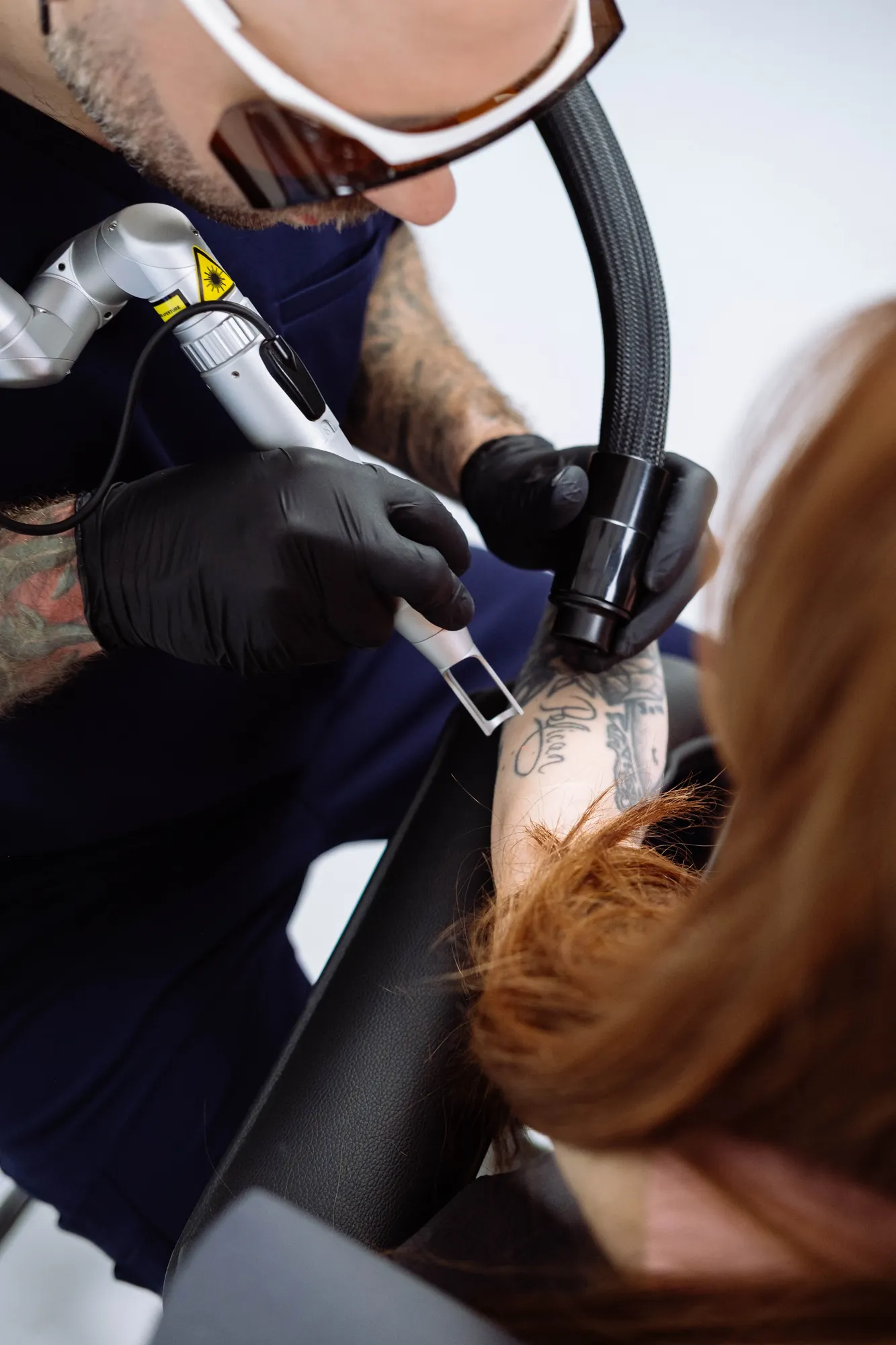
- Laser treatment. The laser passes section by section over the tattoo. You will hear a characteristic snapping sound — this is the photoacoustic effect as the laser shatters ink particles. The sensation is like a rubber band snapping — sharp, momentary, repeated. Treatment over a smaller tattoo takes 2–5 minutes; larger pieces may require 10–15 minutes.
- Frosting — white patches. Immediately after exposure, white patches appear on the skin (frosting). This is completely normal — it is carbon dioxide released from the shattered ink. It resolves on its own within 20–30 minutes.
- Cold pack applied. Immediately after the session a cold pack is applied to soothe the heat and minimise swelling.
- Dressing (if required). For larger areas or more reactive skin a sterile protective dressing is applied.
- Written aftercare instructions. Before you leave you receive written aftercare instructions. Don't assume you will remember everything — you have it in writing.
After the session — the first hours
Immediately after the session the area will be slightly red, swollen, and warm to the touch. This is a normal skin reaction to the laser stimulus. A few tips for the first hours:
- Keep the area cool — a cold pack (not ice directly on skin) for the first 24 hours brings relief.
- Do not massage or rub the area.
- Cover with clothing or a dressing if you are going out in the sun.
- Do not soak in a bath, swimming pool, or the sea for at least 48 hours.
“I recommend laser tattoo removal — I had results after the very first session.”
What to expect in the following weeks
Within 24–72 hours after the session:
- redness gradually fades,
- blisters may form — this is normal for some clients and indicates that the body is responding intensely to the laser stimulus,
- a scab may form — do not pick it; it heals on its own.
The most important point about results: do not judge after one week. The real effect of the session — tattoo lightening — becomes visible only 6–8 weeks after the session, once the body has had time to carry away the shattered pigment particles. This is when the "wow moment" arrives for most clients.
Detailed aftercare guidance is in the article tattoo removal aftercare. If you have questions about what the session feels like, read does tattoo removal hurt. The general overview of the whole process is in how to remove a tattoo. Start with a consultation — prices are on our pricing page.