
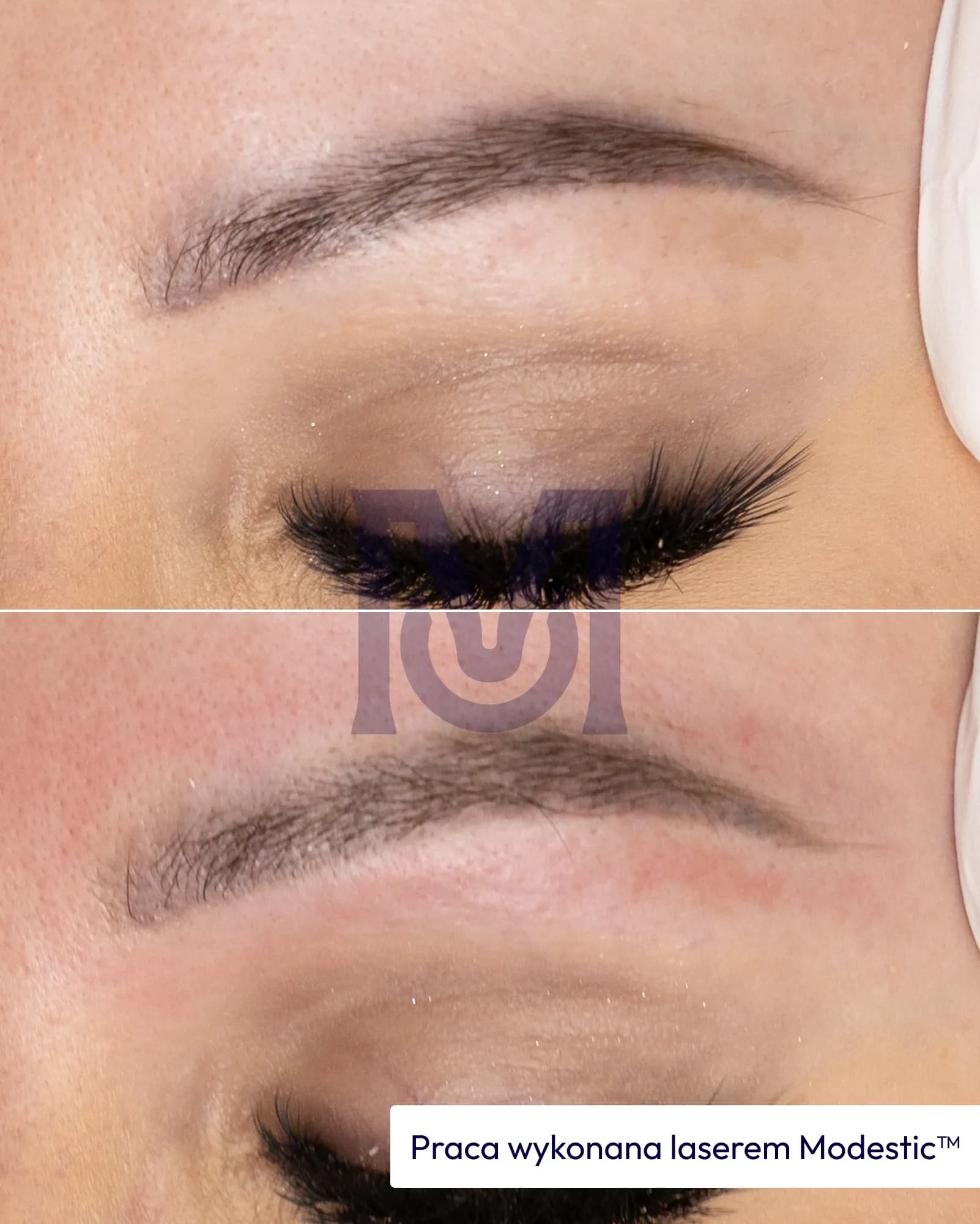
When lightening is enough vs when you need full removal
Lightening (partial removal) works well when:
- the old colour is too dark or too cool, but the shape is acceptable,
- you want to change the colour — say, from dark brown to light brown or taupe,
- the artist doing the new PMU needs a clean base for the new pigment,
- you don't need the pigment to disappear entirely, just to fade enough for the new colour to come out right.
Full removal is the better choice when:
- the old colour has shifted significantly (grey, blue, red) and dominates strongly,
- the brow shape is wrong and the new PMU would have to be done in a completely different position,
- you want to return to natural brows with no pigment underneath.
The line between these options isn't fixed — we work it out together at the consultation, once we've looked at the pigment and heard what result you're after. Full process details are in the guide on permanent eyebrow makeup removal.
How lightening PMU pigment works
Technically, lightening is the same process as removal — only the goal is different. We use a picosecond laser (or a remover, see below) to shatter the pigment particles. The body clears the broken-down pigment over the following weeks. After each session the brows are noticeably lighter — we stop the process when we reach a level that's suitable for new permanent makeup, rather than continuing all the way to zero.
Important: with pigments containing iron oxides (common in light and warm PMU shades) we always do a test spot before the full treatment — some pigments can paradoxically darken on the first pulse. That's a standard step that lets us find safe parameters.
How many sessions lightening takes
Usually 1–3 sessions are enough for the pigment to fade to a level that works under new permanent makeup. That's fewer than for full removal, where the goal is complete clearance (3–4 sessions).
The exact number depends on:
- the saturation and colour of the old pigment,
- the technique used for the original PMU (microblading, ombré, powder — each places pigment differently),
- how light the artist doing the new makeup needs the base to be.
It's best to check with the new artist what level of lightening they need, then bring that information to the consultation — we can tailor the plan to the exact requirement.
How long to wait before new permanent makeup
After the last lightening session the skin needs to fully heal and the body needs to clear the broken-down pigment. The optimal window is usually 6–8 weeks after the final treatment.
Starting new PMU too early — before the skin is fully recovered — can give a weaker result or complicate healing. That's why we give a precise timeline individually, once we see how the skin responds.
“Full professionalism. The specialist explained everything step by step.”
Remover or laser for lightening
For lightening eyebrow PMU we can use either a picosecond laser or a chemical remover. In brief:
- Laser — works through the skin without breaking it, precise, safer for tricky pigments (after a test spot). The standard method.
- Chemical remover — a substance introduced into the skin that draws the pigment to the surface. Can work faster on some pigments, but leaves a scab that needs to heal. A good option for pigments that respond poorly to laser.
Often the two methods complement each other — we decide after assessing the pigment. A detailed comparison is in the guide remover vs laser for PMU removal.
If you're planning a change to your eyebrow permanent makeup, the first step is a consultation — we'll assess the old pigment and plan lightening to suit the requirements of the new makeup.