
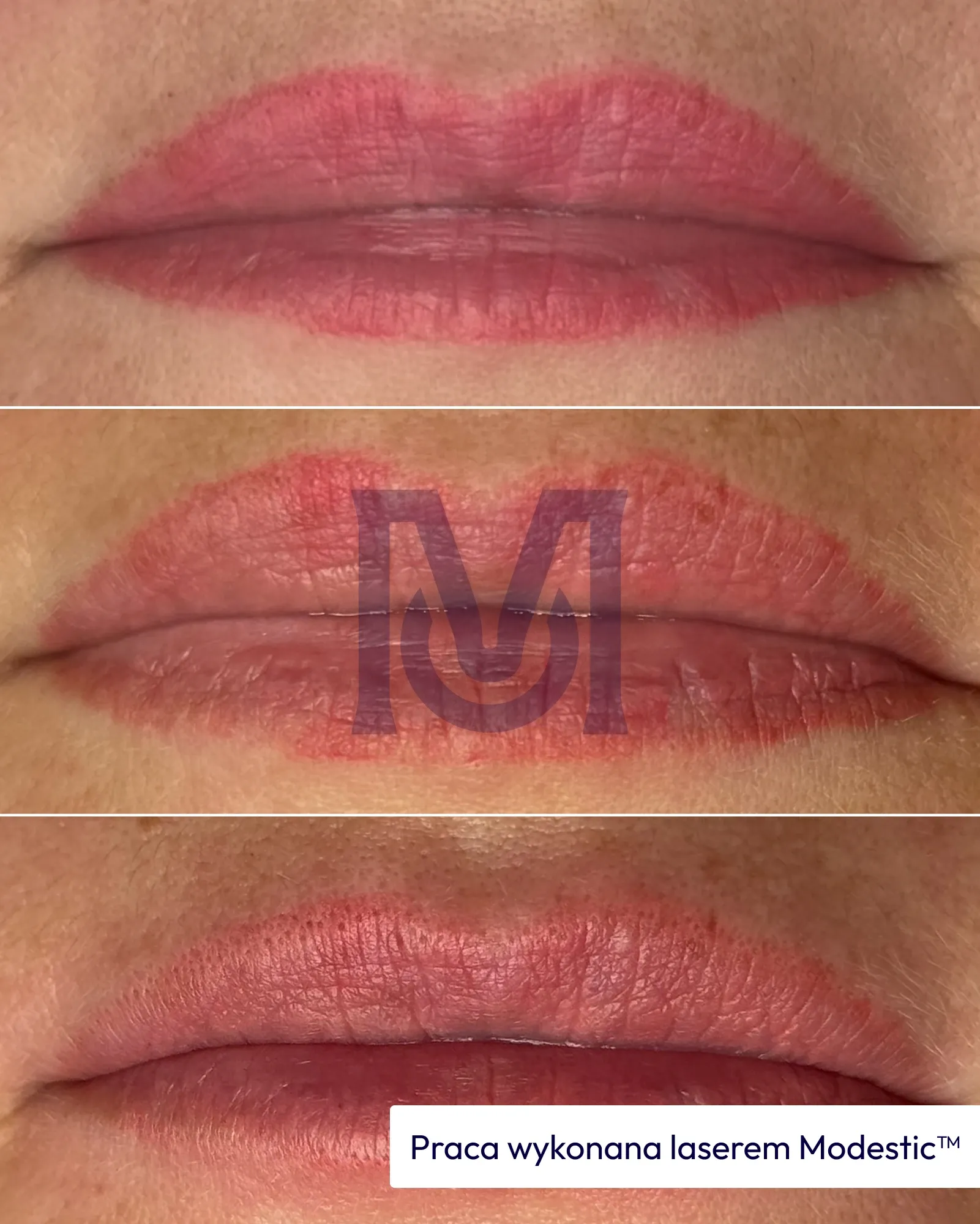
First hours after treatment
Immediately after the session the treated skin will be red, slightly warm and may be mildly swollen. This is a normal response to laser energy and typically resolves within a few hours. You may also notice frosting — white patches on the skin — right after the laser pulses. This is CO2 gas released during the laser-pigment interaction. It disappears on its own within minutes and needs no action.
For the first 24 hours keep the area dry: no makeup, no vigorous washing, no pool or jacuzzi. Gentle cleansing with clean water and a mild, alcohol-free micellar solution is all that's needed.
First days — what is normal
Between days 1 and 5 a thin scab may form over the treated area. With laser-only removal it is usually more subtle than with saline or chemical removers. Regardless of its thickness, one rule always applies:
Do not pick or scratch the scab. The skin underneath is working. Removing the scab prematurely can cause scarring or push broken-down pigment deeper into the tissue, making it harder to clear.
Between days 5 and 14 the scab separates naturally and the skin looks lighter. This is correct healing, not an error. The full effect of pigment removal becomes visible only after several weeks — the body needs time to transport the fragmented pigment away.
Care between sessions
Weeks 2–8 after the session are when the body is actively clearing the broken-down pigment. This is when you can really see how much the skin has released. There is not much to do in this phase — which is correct:
- Moisturise gently — a light cream without retinol or acids is enough.
- Apply SPF outdoors — sun protection is one of the most important elements of aftercare. Skin after laser treatment is more prone to hyperpigmentation when exposed to UV. Use SPF 30–50 every day throughout the course of sessions.
- Do not panic after the first session — the effect is cumulative. Initial lightening can be modest; visible change usually accelerates from sessions 2–3 onward.
What to avoid between sessions
- Sauna and hot baths — for at least 2 weeks after treatment. High temperatures dilate blood vessels and can intensify skin reactions.
- Swimming pool and sea water — chlorinated and salt water irritate healing skin. Wait at least 2 weeks or until the scab has fully separated.
- Direct sun on the treated area — if you cannot cover it with clothing, apply a high-SPF sunscreen.
- Scratching and rubbing — even if the skin itches (a normal healing stage). Itching signals the skin working, not a problem.
- Active skincare ingredients — acids (AHA, BHA), retinol and chemical peels on the treated area until fully healed.
“Just half an hour after the treatment I could go back to work. I had no scabs or weeping at all.”
When to contact the clinic
Normal redness, mild swelling and a scab are expected. Call or message us if you notice:
- Pain that worsens rather than eases after 48 hours.
- Signs of infection — spreading redness, warmth, discharge from the wound or fever.
- Blistering larger or more painful than described at the appointment.
- Allergic reaction — intense itching, hives or swelling beyond the treated area.
For more on what the treatment itself feels like and how we keep it comfortable, read: does permanent makeup removal hurt.
If you are considering your first session, start with a consultation — book online. Current session prices are in the price list.