
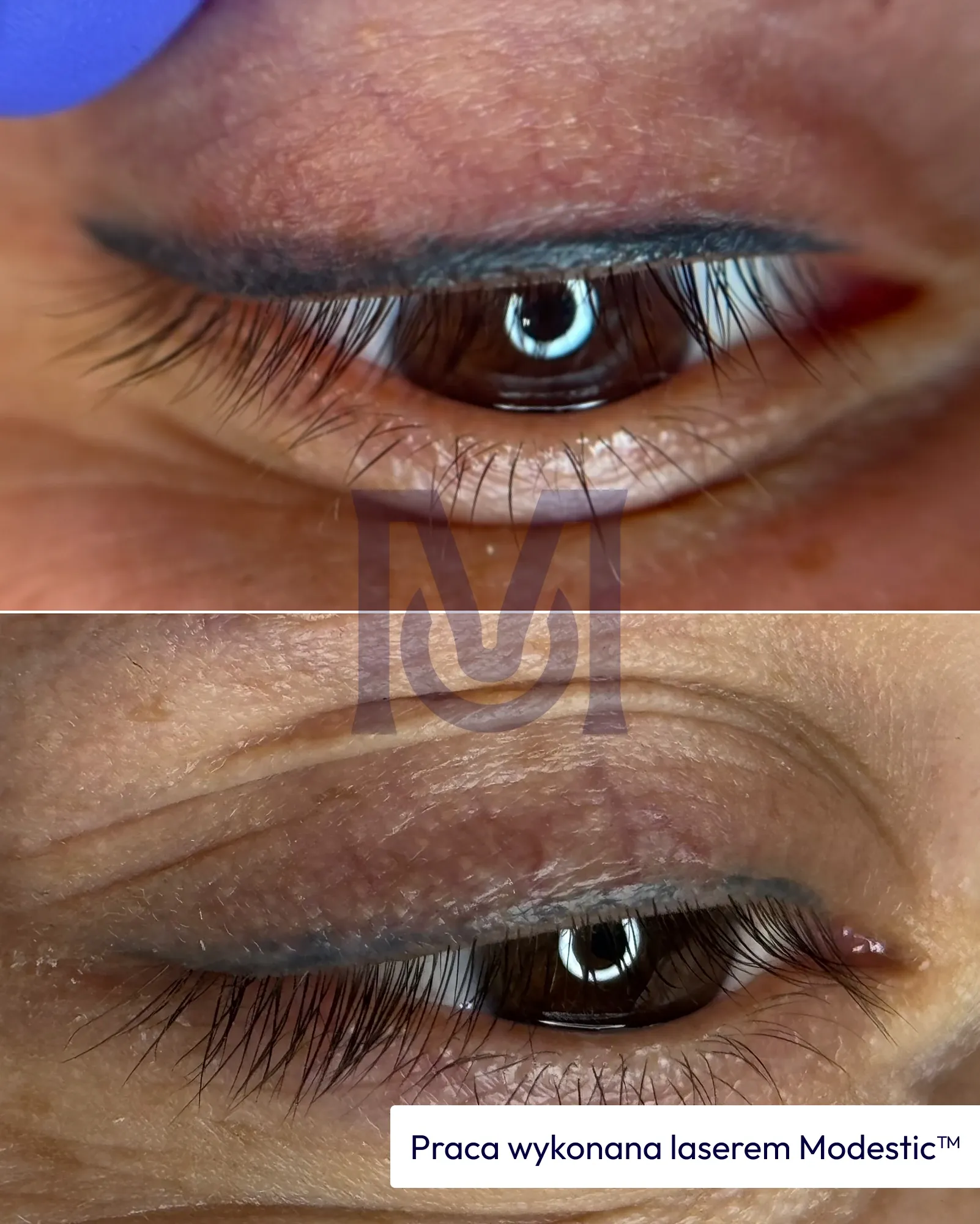
Wrong colour — how to spot it
After healing, permanent makeup colour can shift from the intended result in several characteristic directions:
- Too dark or too intense. Brows look drawn on with a marker — sharply contrasting with natural hair, heavy and solid with no gradation. The effect is amplified when pigment is implanted too deep and spreads under the skin.
- Ashy or blue-grey. Brows that were supposed to be brown look drawn with a grey or bluish pencil a few months later. The cause is usually too-deep implantation, or a cool-based pigment that changes appearance through the skin over time — the same reason veins look blue.
- Purple tone. A typical result of pigments that were not fully colour-neutral — once the darker layer fades, a purple or plum undertone remains.
- Orange, ginger or rusty tone. Usually the warm "base" of iron-oxide pigments surfacing once the dark layer fades — the ginger underlayer shows through. Especially visible with light brown and blond pigments, but occurs with dark ones too.
Each shade suggests a different correction path — which is why assessing colour is the first step at the consultation. We discuss colour problems for brows in detail in the article on botched permanent eyebrow makeup.
Wrong shape
Shape is the second equally important category of errors. Unlike colour, correcting shape is harder — new pigment placed over a wrong shape only locks the mistake in.
- Brows too low or too high. If the arch starts too low relative to the eye, or the arch is lifted too high, facial proportions are noticeably disrupted.
- Asymmetry. Different height, different arch direction, different tail length on each side — obvious asymmetry is visible even to a non-specialist.
- Wrong tail direction. A tail angled too horizontally (a look of surprise) or too sharply downward (a look of sadness).
- Too wide or too narrow. Brows that don't fit the natural hair zone — clearly outside it or occupying only its centre.
Shape can only be corrected by removing or significantly lightening the old pigment before an artist places new brows in the correct position.
Technique problems
Some flaws result from how the procedure was performed — not just from colour or shape choices.
- Hairstrokes merged into a solid block. Microblading creates fine hairlike strokes meant to look natural. If placed too densely, too deep, or on skin with large pores, they grow together after healing into a uniform dark patch instead of a tuft of individual hairs.
- Patchy ombré. Uneven colour density — areas where the pigment sits thick and areas where it is barely present.
- Blurred edges. The outline is not sharp; pigment has migrated beyond the intended line under the skin — a blurry effect, as though the PMU was applied out of focus.
Botched lip PMU and eyeliner
Lips and eyeliner have their own error categories — we cover them in detail in botched permanent lip makeup and botched permanent eyeliner. A brief summary here:
- Lips — outline outside the natural lip border. Pigment placed beyond the natural edge of the lip makes the lips look much larger — or creates a shape disproportionate to the face.
- Lips — wrong colour. Too fuchsia, too dark, too warm — or uneven healing leaving some patches pale and others dark.
- Eyeliner — different thickness on each eye. One eye has a thicker or thinner line, making the eyes look asymmetric.
- Eyeliner — different height on each eye. One line sits higher than the other — noticeable when looking straight into the mirror.
- Eyeliner — migrated pigment. The pigment has crept beyond the lash line, creating a blurred or smudged edge.
How to tell healing from a real error
This is the key question — and the source of a lot of unnecessary distress. Right after the procedure, every permanent makeup looks too dark. This is normal and applies to all techniques: microblading, ombré, eyeliner, lips.
During the first 2–4 weeks, fresh PMU:
- is noticeably darker than the final result will be,
- may look uneven or intense in spots where the skin absorbed more pigment,
- flakes — and lightens as it flakes,
- may look pale or patchy right after flaking (a transitional stage).
What you see 4–6 weeks after the procedure is close to the final result. Only then can you properly assess colour and shape. If after 6 weeks the PMU still looks wrong — colour clearly shifted, shape off, lines blurred — that is a genuine problem, not a healing stage.
If you're unsure after 6 weeks have passed, come in for a free assessment — you don't need to decide on your own whether something is wrong.
“My eyebrows went from an ugly grey shade back to a natural brown.”
What to do about botched PMU
The first rule: don't act immediately. Even if the PMU clearly looks wrong at 6 weeks, laser removal can begin no sooner than 6 months after the procedure. The skin must be fully healed and the pigment stabilised. Earlier laser treatment increases the risk of scarring and gives worse results.
- In the meantime, makeup can camouflage. A corrector matched to your skin tone can effectively conceal brows or liner when the PMU is too dark or the wrong shape.
- Consult a PMU artist. A good specialist will assess whether the PMU needs removal, correction, or whether a touch-up can fix it.
- After 6 months — laser consultation. We assess the pigment, agree a plan, and discuss how many sessions are needed and what result is realistic. Book a consultation.
Laser PMU removal prices and cost ranges for different session counts are listed on the price list.