
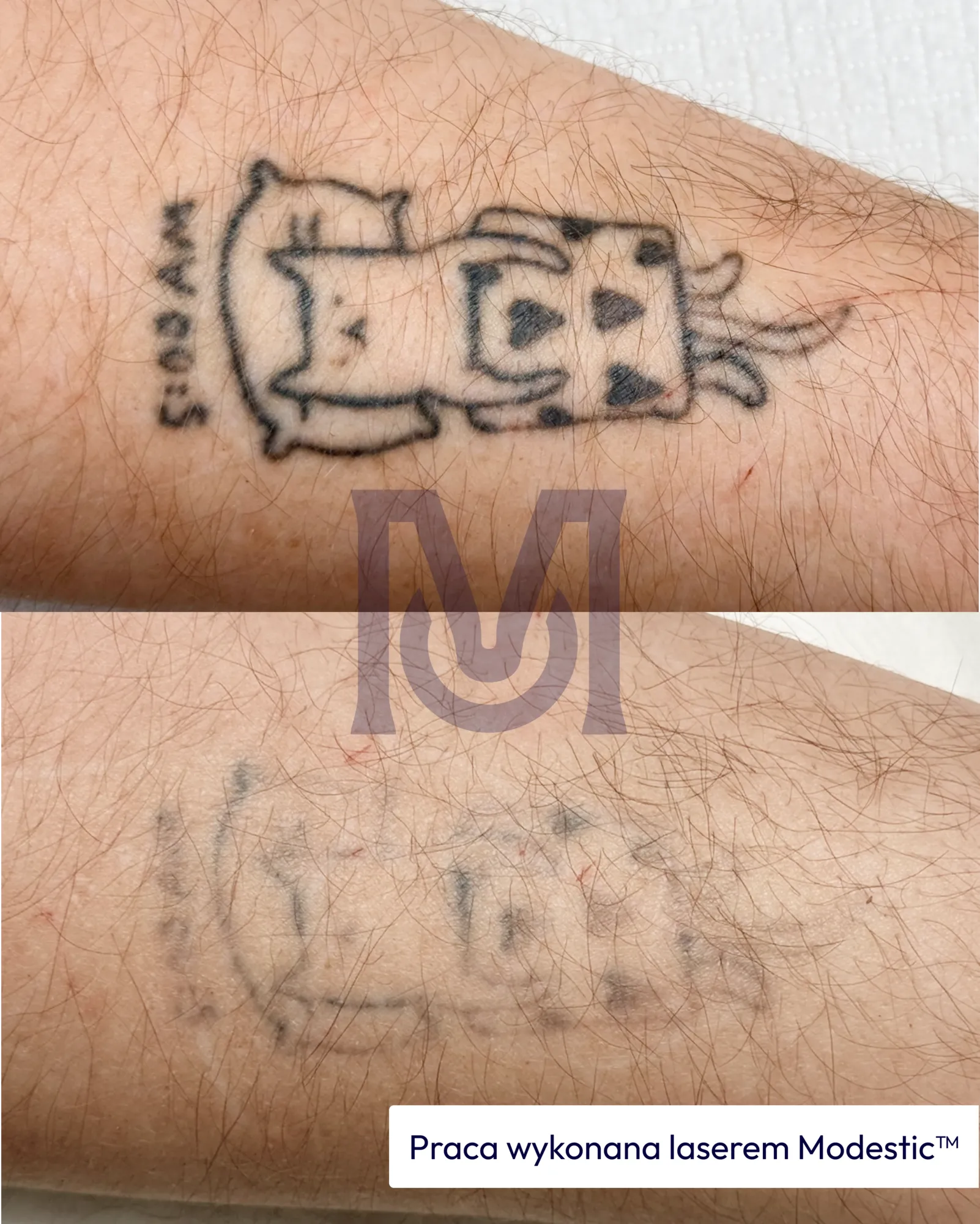
What is an amateur tattoo
The term "amateur tattoo" covers a wide range of situations: a design done at home by a friend, a tattoo made with a needle and pen or india ink, the stick-and-poke method (manual skin puncturing without a machine), and prison tattoos made with improvised tools from soot, graphite, or ink. The common denominator is the absence of professional equipment — and, often, an unknown ink composition.
What's different under the laser
Several characteristics of amateur tattoos set them apart from professional designs when working with a laser:
- Shallower and uneven depth. Amateur puncturing rarely reaches the dermis consistently. Some ink may sit very shallow — near the epidermis — while other sections reach a typical depth. Shallower ink is more accessible to the laser.
- Uneven density. Areas of heavy ink sit next to almost empty patches. Removal results will therefore be uneven — some sections will clear faster, others will resist longer.
- Lower overall ink volume. Without a tattoo machine it is hard to deposit as much ink as a professional. Less ink typically means fewer sessions.
- Unknown pigment composition. This is the most important difference. Professional pigments have a known composition; pen ink, drawing ink, or an improvised mixture may contain substances that react to the laser differently — or not at all.
Unknown ink — what it changes
The picosecond laser breaks down pigment that absorbs specific wavelengths of light. Professional tattoo pigments are largely based on known ingredients (black is typically soot — carbon), which makes them react predictably.
Pen ink, drawing ink, and especially homemade mixtures may contain metals, organic dyes, or paint pigments that:
- respond very well to the laser (e.g. carbon-based dyes),
- do not respond at all, or respond weakly (some synthetic dyes),
- in rare cases may change colour after exposure to the laser or behave unpredictably.
This is not a cause for alarm — the effect occurs in only a small percentage of cases and is well known to laser therapists. It is worth mentioning at the consultation what the ink might have been, if you have any idea.
Prison tattoos and "soot tattoos" are often almost pure carbon — which absorbs the laser extremely well. These designs can be among the easiest cases, clearing in as few as 3–5 sessions.
“I'm in the middle of removing an ill-considered tattoo — even the first session shows visible results.”
How many sessions to expect
In general, amateur tattoos clear faster than professional ones, but it is harder to give a precise session count than with classic tattoos. Some rough ranges:
- Home tattoo / stick-and-poke with drawing or regular ink: often 5–8 sessions, depending on density and depth.
- Stick-and-poke with professional tattoo pigment: behaves more like a professional tattoo, though it may still be shallower — roughly 6–10 sessions.
- Carbon / prison tattoo: potentially 3–5 sessions with a good laser response.
These numbers are indicative — the only way to get a precise estimate is a consultation and a laser test patch. Sessions are spaced approximately 8 weeks apart; more on that in the article on how many sessions tattoo removal takes.
How the laser itself works is explained in how laser tattoo removal works. A full overview of the process is in the guide how to remove a tattoo. Book a consultation to assess your specific case — indicative prices are on our pricing page.