
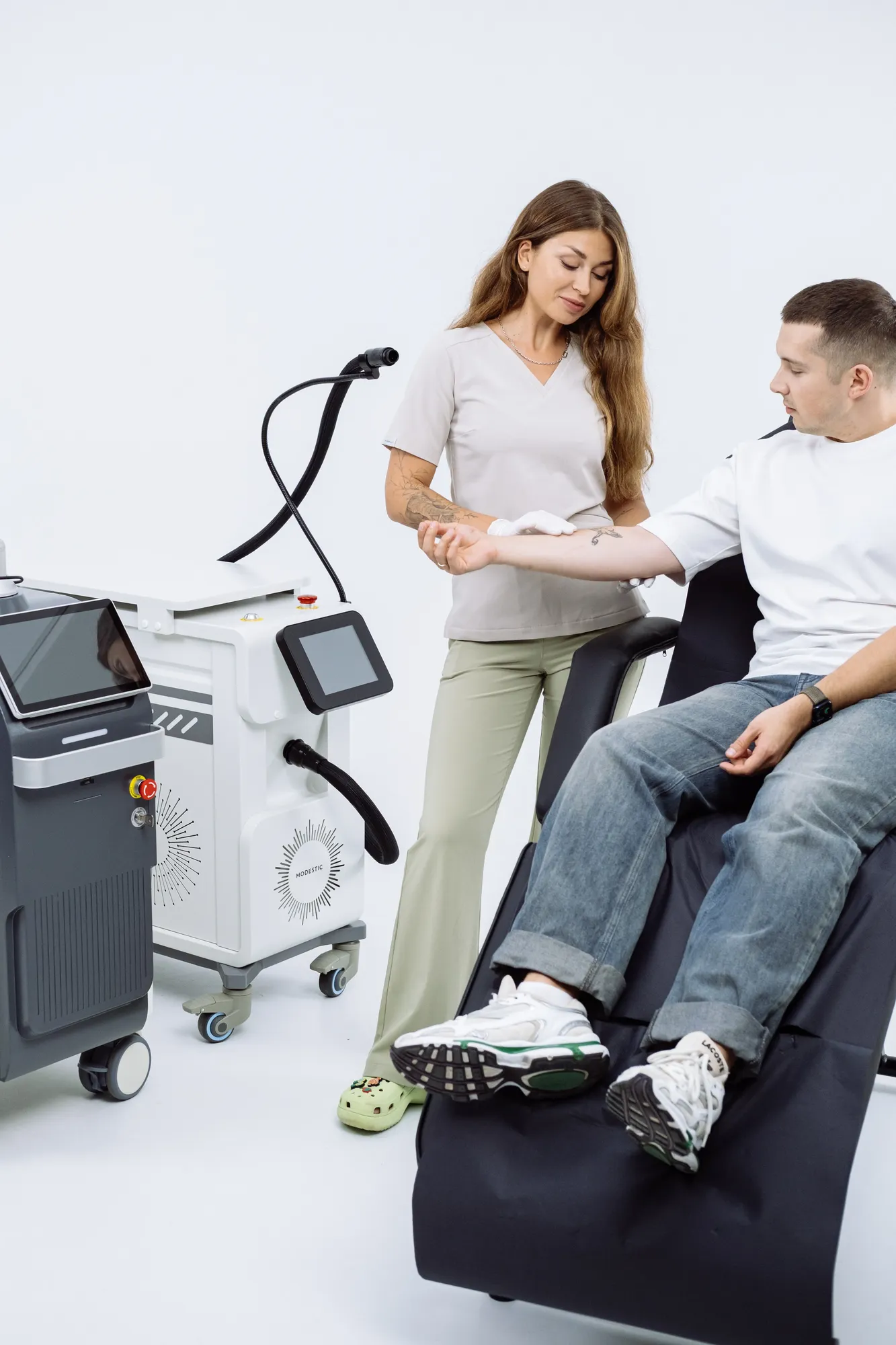
Where a tattoo most often gets in the way at work
The issue mainly concerns visible tattoos — the ones a sleeve or collar won't cover:
- Hands and fingers — the hardest to hide, often the first reason to remove.
- Neck and nape — visible above the collar, a problem in uniform and in formal dress.
- Face — practically impossible to cover at work.
- Forearms — visible with short sleeves or rolled-up cuffs.
In uniformed services (police, military, the guard) the rules can be strict and may decide recruitment. In corporations, banks and the civil service it's more often about dress code and first impressions, but the pressure can be similar.
The maths of time — why this isn't a last-minute job
Laser tattoo removal is a process, not a single treatment. Fully removing a professional tattoo usually takes 8–12 sessions spaced about 8 weeks apart — the gap is needed so the body clears the shattered pigment and the skin recovers. That adds up to more than 12 months, often closer to a year and a half. The process can't be safely rushed. We break it down in our guide how many sessions tattoo removal takes.
Planning backwards — from the recruitment date
The surest method is counting back from the date that matters to you (recruitment, starting work, medical checks). If you have a firm deadline:
- Set the date by which the tattoo should be removed or maximally faded.
- Subtract about 12–18 months for a full course of 8–12 sessions every ~8 weeks.
- That points to when to start — ideally with a buffer for unexpected breaks.
The earlier you start, the more comfort you have and the lower the risk the tattoo won't be gone in time. We use the same "count back from the date" logic for tattoo removal before the wedding.
Full removal or partial fading
You don't always need to aim for complete removal. If time is short or the rules allow a tattoo that's "coverable", the goal can be significant fading, so the tattoo is easy to mask with foundation or clothing. A partial fade usually needs fewer sessions than full removal to zero.
- Full removal: 8–12 sessions, over a year — when the tattoo must disappear.
- Significant fading: fewer sessions — when it's enough for the tattoo to be easy to cover.
“Fast, smooth service with great results. Highly recommend.”
What to do now
If you know a tattoo might clash with your job or recruitment, the best decision is to check a realistic plan as early as possible — even if the final deadline is far off. At the consultation we'll assess the tattoo, estimate the number of sessions and count the time back with you, so everything comes off without rushing.
The simplest step is to book a consultation and work out exactly how much time you need.