
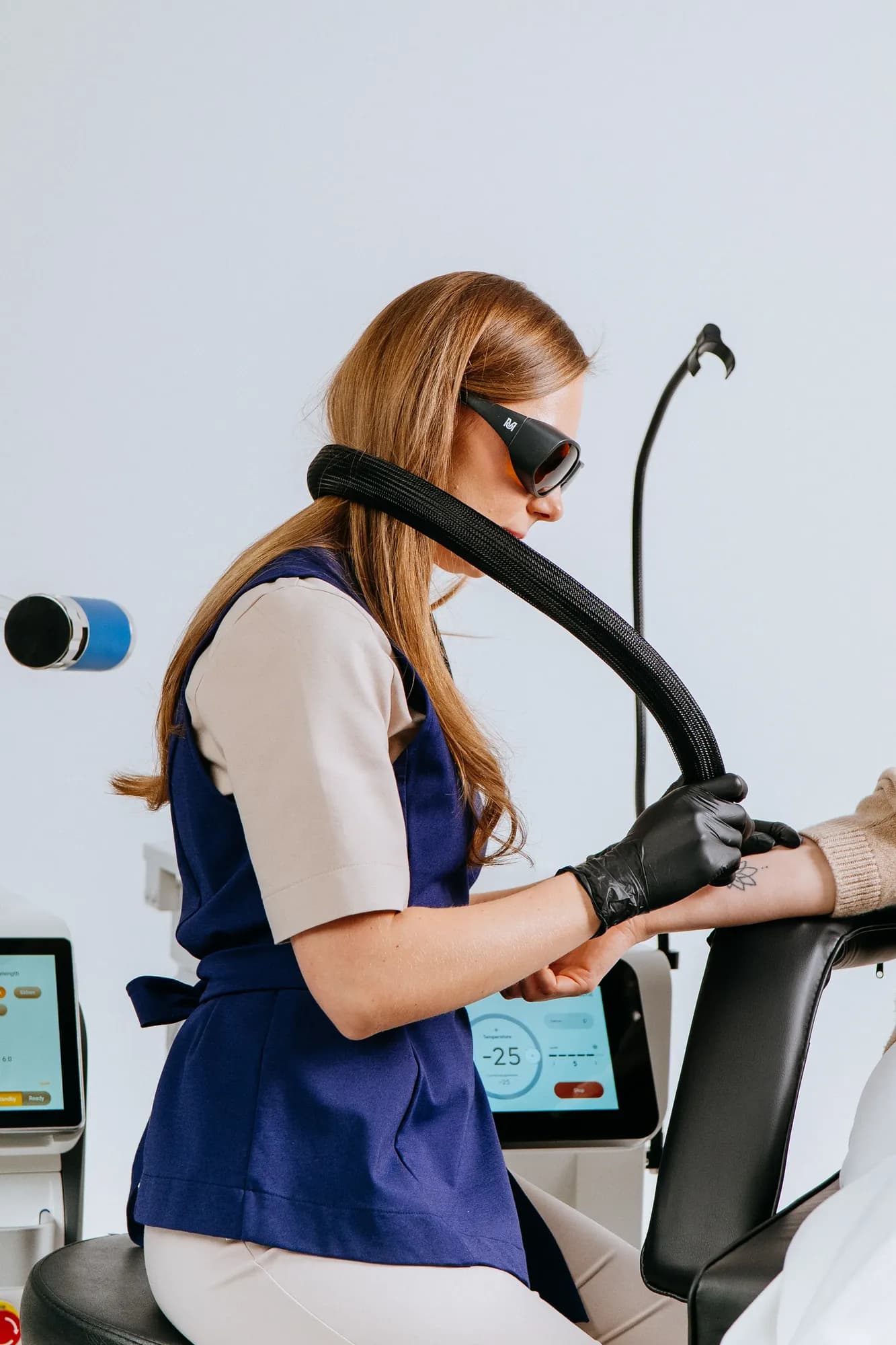
What happens during the session
Each picosecond laser pulse strikes an ink particle and generates a photomechanical shock wave that shatters the pigment into far smaller fragments. This is not "burning" — the laser does not physically extract the ink from the skin; it breaks it apart.
Immediately after the pulses, the skin shows a white colouration known as frosting. This is carbon dioxide (CO₂) released by the microscopic heating of tissue. Frosting is harmless and resolves on its own within 20–30 minutes. Many clients ask what it means — it is simply a sign that the laser has hit its target.
The general physics of the process is explained in more detail in our guide on how laser tattoo removal works.
First hours — the immune response
After the session the treatment area is red and swollen — a normal inflammatory response. The body recognises tissue damage and mobilises the immune system.
Macrophages (phagocytes) — specialised immune cells tasked with engulfing foreign particles and pathogens — migrate to the treatment site. They surround the shattered ink fragments and begin "packaging" them inside themselves, ready for transport.
This is precisely the same mechanism that makes a tattoo permanent in the first place: pigment particles were too large for macrophages to clear, so the body walled them into the tissue. After laser treatment the particles are small enough for phagocytes to grasp.
Weeks after the session — the body's work
Over 2–14 days, macrophages transport the engulfed ink via the lymphatic system to the nearest lymph nodes — usually inguinal (for tattoos on the leg or hip) or axillary (for tattoos on the arm or chest). Some particles are also absorbed by local fibroblasts. If there was surface skin trauma (blisters, scabs), healing also occurs during this period.
From 2 to 8 weeks after the session the main clearance phase takes place: lymph nodes filter and process the ink fragments. The fading effect on the tattoo is most visible in this window — not immediately after treatment, but over the following weeks.
Important note: the ink does not "disappear" chemically. The body does not break the dye down into colourless compounds. It moves it from the deeper layers of the dermis to the lymph nodes, where tiny particles are permanently sequestered. From the skin's surface this appears as tattoo fading.
For guidance on what to do between sessions to support healing, see our tattoo removal aftercare guide.
“After just four sessions I can already see a major improvement. I'd recommend it to anyone considering tattoo removal.”
Why the gap between sessions is essential
The entire biological clearance process — from macrophages engulfing the fragments to lymph nodes filtering them — takes 4 to 6 weeks. The skin also needs additional time to fully heal from surface trauma: 2–4 weeks.
If you come for the next session too soon:
- Macrophages are already occupied with debris from the previous session and have no capacity for new material.
- The new session generates more debris than the immune system can handle at once.
- Net result: less efficient clearance and a higher risk of adverse reactions.
That is why the minimum gap between sessions is 6–8 weeks. This is not an arbitrary recommendation — it is the time biology requires. We regularly see clients who had sessions at other clinics every 3–4 weeks and saw little progress.
For more on how many sessions are needed and what the full process involves, see our guide on how many sessions tattoo removal takes. To discuss your own case, book a consultation — reserve a time slot. Pricing on our pricing page.